
You’ve heard this one before; President John F. Kennedy encountered a janitor on one of his tours of NASA. Upon asking the janitor what he did for NASA, his answer is written in the files of history: “Sir. I am helping to put a man on the moon!”
In reality, the janitor went on to say that his mission was to “keep the facility clean and tidy so that the engineers and scientists could focus on their mission of creating a rocket capable of safely transporting astronauts to the moon and back”. However, as a soundbite, it’s not quite as catchy!
So, fallacy or not, the sentiment behind the analogy is that everyone in your organisation should buy into your vision, and then know what is required of them to achieve it.
But how do we do it? I have been in the fortunate position of being able to translate strategy into action on more than a few occasions. The terms Hoshin Kanri, X-Matrix, Strategy Planning (and many more names) are used frequently, but it’s not the tool; it’s the process that will make or break it.
By following the points below, you will gain an edge when it comes to effective policy deployment.
1. Set the vision
Firstly, we need a vision; something that we can all buy into.
Across industry, a whopping 63% of employees don’t have a clear understanding of what their company’s vision is. Context-wise, the average ratio of direct to non-direct in a manufacturing business is 60:40; therefore, is it only the management team that understand the vision? This will need changing.
2. Determine the medium-term objectives
Once we have that, turn your strategy into targets or Breakthrough Objectives. Your strategy should aim for 3-5 years and be based on the vision, so these objectives should encapsulate everything needed to achieve this.
Make the objectives stretched, but SMART (Specific, Measurable, Achievable, Relevant, Time-bound), but more importantly at this stage, make sure they align with the forecast. Breakthrough objectives are the forecast, and not a separate process.

DUNCAN RILEY
Business Transformation Coach
3. Set annual objectives
Now we can start the process of deployment. If we know what 3-5-year objectives look like, what do we need to achieve in a year? At this point, we need to start involving our next tier of management. Let them be part of setting annual targets, but:
a) they need to understand the 3-5-year objectives and the journey to get there
b) you get the final say, since you are in control of your journey
4. Set the priorities for action
We now have annual objectives – each one is linked to the 3-5-year objectives and the year’s budget. In doing the above, you have a built-in commitment from the next tier to achieve it! Let’s now get the buy-in from the next tier and beyond – what projects/activities/priorities do we need to do in the year to achieve the objectives within budget?
As you are in control, you take on the roles of coach, facilitator, and problem solver. Your role is to make sure that every one of those priorities are enough to achieve the annual budget, and that the resource planning of the project is achievable. Beware: this will be your biggest barrier, so make sure you pay close attention.
If what is presented to you does not add up, then play catch-ball; throw the ball back and forth to them until there is an agreed objective in place. It may even mean that you have to amend the budget but guess what; your strategy has been bought into by more than just the people at the top, so there could be some leeway.

5. Measure success of the business priorities
Having a plan and enacting a plan are two very different beasts. What you don’t measure, you don’t get!
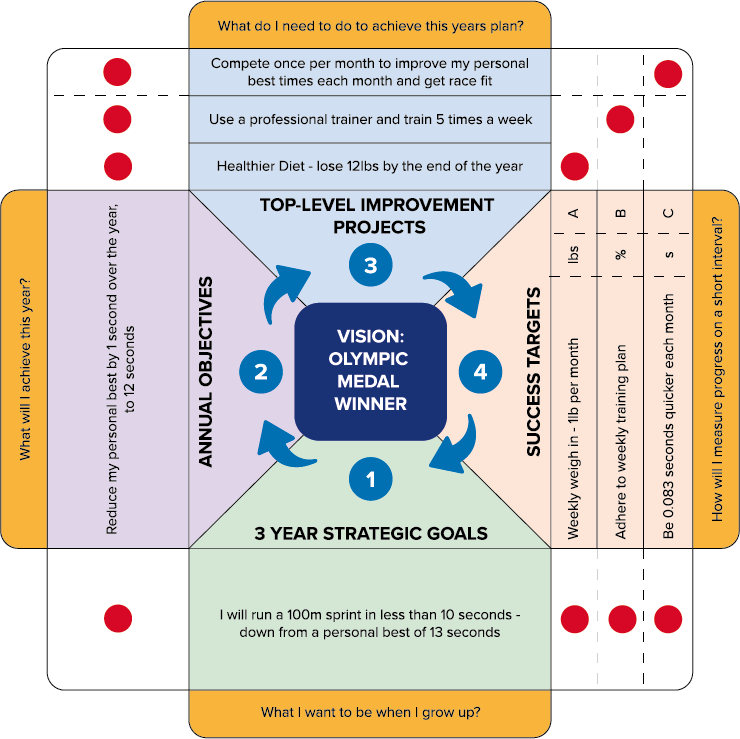
You now have the mechanism to set the right KPIs that will drive the right behaviour. Every KPI that is now set has direct links to your strategy and your vision All you need to do now is set the right interval of measure, and the reporting structure that will build any additional accountability required. You now have an x-matrix, a plan-on-a-page linking all activity to the strategy.
Note: As a deployment architect of many years, if there isn’t a process in place, I would be looking to set this process running on month six of the year, ready for the new financial year!
6. Set the review process
Each one of these priorities will have milestones that need to be met to achieve success, as well as hurdles that need to be overcome. With a timely project/priority/Level 1 process in place, you will only need to oversee the bigger picture.
Setting a top-level Master Schedule/Level Zero/Milestone Plan that gives visibility of what needs to happen and when, and then monthly reviews against the milestones and the KPIs, will ensure you make progress. At the same time, you will be retaining ownership and autonomy. Your role is then to help navigate those hurdles through problem solving escalation
7. Review and align
Your short-term deployment Management Control and Reporting System (MCRS) is now in place, but things change. Significant effort has been put into aligning the workforce with the strategy and vision, so we need to maintain that alignment when things inevitably change.
You now have a Strategic Policy Deployment process in place!
Designing a tailored strategic policy deployment process is straightforward, but like anything, it will take time and effort to embed into the spine of your business. However, once it is in and driving behaviour, it is truly transformational. Soon, everyone will be telling you how they “helped to put a man on the moon”.
I hope you enjoyed reading and learning from this article! If you want to learn more about how SiG can accelerate your business growth, click here. You can also follow SiG on LinkedIn by clicking here.