Steven Bryan
Procurement Coach
Can supply chain management influence an organisation by identifying and leading strategic decision-making? How can supply chain efficiency be combined with cost savings and resilience? Given its broad impact on a business, supply chain management is uniquely positioned to understand the bigger picture and identify operational opportunities.
While most businesses inherently understand their supply chain, both established and newer companies should consider reevaluating their current footprint. This assessment can determine if the existing infrastructure has become ineffective or inadequate to support the business plan, potentially becoming a constraint.
Addressing challenges and opportunities
With businesses currently struggling to maintain profitability amid rising costs of goods, materials, transportation, rent, and labour, there’s no better time to act. This situation presents both challenges and opportunities for supply chain professionals to increase efficiency, resilience, and cost-effectiveness while maintaining or improving service levels to meet or exceed business and customer expectations.
For example, consider a business with a central HQ, satellite branches, and multiple warehouses (as shown in Diagram A). The entire supply chain operation should be analysed to determine if this model is still effective and capable of providing the competitive advantage and performance the business and customers require.

Optimising the supply chain
When conducting this type of analysis, the importance of internal relationships and service levels to customers cannot be emphasised enough. An integrated approach, combined with cross-functional understanding and close collaboration with all stakeholders, is essential for ensuring a positive outcome.
All data needs to be analysed in detail. Without wanting to preach to the well conversed in this subject, the initial points to analyse to develop the strategy and to put the pieces in place should consider the following:
- Assess the current supply chain and logistics network, including delivery service levels and associated costs.
- Identify any duplicate roles and evaluate their performance levels.
- Define the key issues – whether they are business-related, operational, customer-focused, or a combination of all.
- Determine the required product portfolio by conducting a detailed review of segmented product categories. Analyse costs and margins to identify product lines that align with the business strategy. Consider eliminating low-volume or unprofitable products that do not support the overall strategy.
- Understand the business plan assumptions for the next two to five years, focusing on sales and operating profit.
- Address resistance to business model changes with data analysis and strategic reviews.
- Define service level requirements by customer and region, and determine delivery times accordingly.
- Optimise the distribution strategy and network. Ensure disciplined channel management, and consider assigning smaller customers to distributors.
- Analyse transportation costs based on customer locations and business volume. Ensure an efficient, cost-effective flow of products to meet service level requirements.
- Consider carbon emissions in the supply chain, as customers may prefer to work with environmentally friendly suppliers.
- Identify and mitigate risks, especially in locations managing critical supplies. Develop a disaster recovery plan.
- Ensure labour availability, skills, and resources are aligned with the business model.
Potential benefits of optimising the supply chain
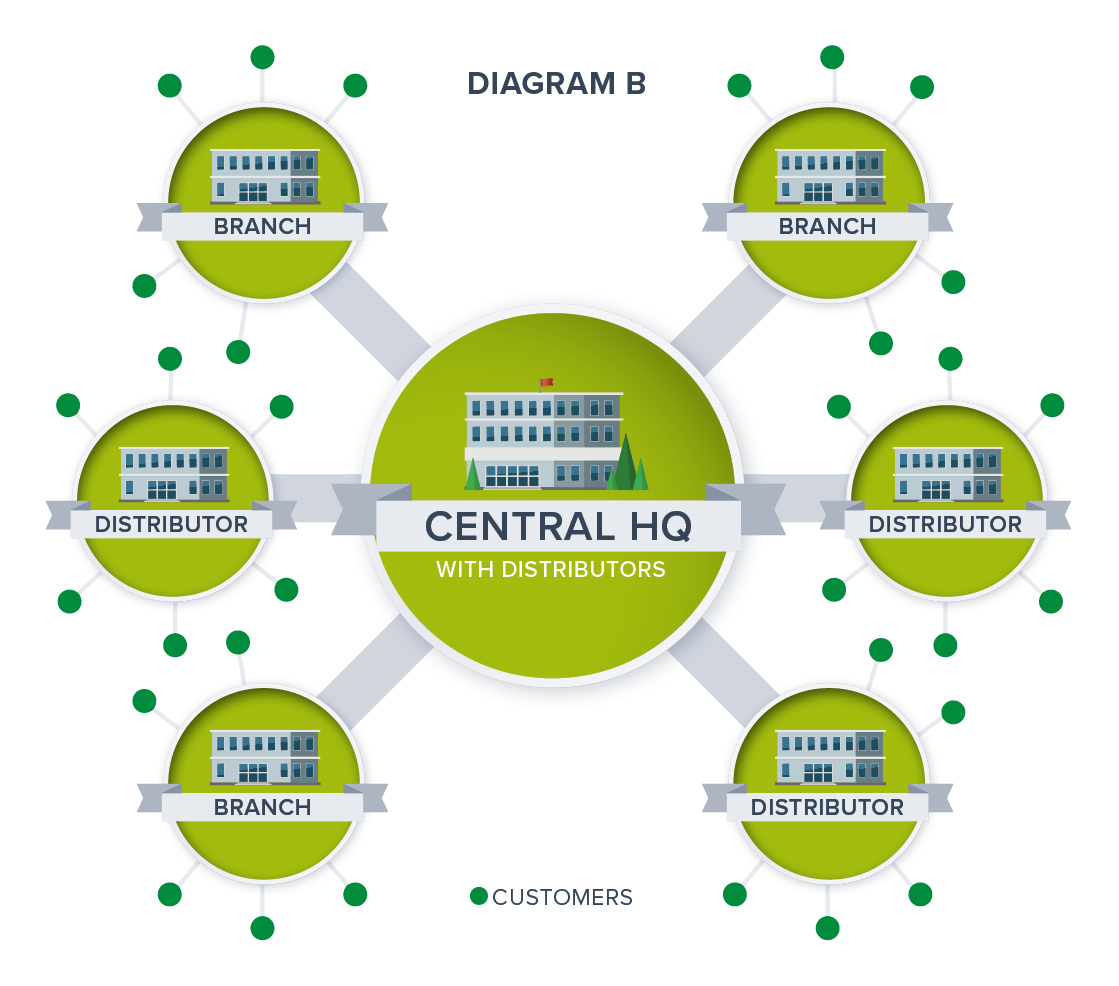
The example given below, a central HQ operation with distributors (diagram B), could provide the following benefits:
- Right size departments
- Consolidate functions
- Overhead reduction
- Improved operational performance
- Risk identification and mitigation
- Stock reduction by elimination of local warehouse stock held by branches
- Product portfolio rightsizing
- Freight cost reduction due to reduced inter-warehouse stock movements
- Improved stock availability and lead-times to customer
Embracing the constant change
Hybrid models can offer significant benefits, but calibrating the supply chain to meet business requirements is challenging, and no single solution fits all. Balancing these elements is crucial for strategic decision-making to ensure a positive impact on companies, business goals, and customers.
Optimisation modelling for product flow and cost reduction can support business decisions. However, the key lies in innovative thinking, proactive actions, flexibility, and the ability to adapt to change, ensuring that the business case is accurate and the right decisions are made.
With strategic focus and creative thinking, supply chain management can leverage existing infrastructure to build a more effective and efficient model, enhancing profitability and competitiveness for both companies and customers.
A supply chain that uses an optimal implementation process and an effective management system will consider all aspects, including supply performance, risk mitigation, and sustainable partnerships with customers and suppliers.
The subject matter discussed in this article is just one of many possible within the vastness of supply chain. Whatever the decision on how to reevaluate the supply chain, the potential for novel approaches should be periodically analysed, allowing supply chain to proactively improve in an infinite number of ways such as efficiency, cost savings and resilience.
But be careful, there is nothing more constant than change in the global, forever evolving supply chain.