I’m drawing from my experience of creating sales strategies alongside my clients as a Business Development Coach. No lengthy list of models here (there’s ChatGPT for that); just practical insights. For Managing and Sales Directors, the pursuit of revenue growth feels like a constant quest for a secret formula. Amid daily chaos, crafting a clear sales strategy often becomes secondary. Many see strategising as abstract, not “proper work,” leading to vague goals and missed opportunities.
Why bother?
Sorry, not sorry. In this post, I find myself referring to clichés, and somewhat trite and laboured metaphors and similes. I embrace them as they are great shortcuts, if a little too well-trodden. An unclear sales strategy is like blindfolded sailing in a vast sea. You might randomly run into success (convincing your colleagues you planned it), but it is not sustainable. In today’s market, a robust sales strategy is essential, serving as your compass, distinguishing between surviving and thriving.

WARREN WEBB
Business Development Coach
I don’t have time for strategic planning
We can fall for the illusion that constant firefighting is the only way to operate. Some businesses even reward this chaotic approach, creating a mirage of productivity. A thoughtful strategy doesn’t require endless hours; it’s about focused, efficient processes aligning your team with business goals.
A well-formed strategy is easily delegated. Crucial for SMEs (where the emphasis is on the S) when delegation isn’t an option; it guides priorities, pinpointing what’s not worth doing. Crafting a thoughtful strategy demands reflection, a worthy investment of your time and bandwidth. Spend your time working on the business, not in it.

TOP TIP
Eisenhower Matrix
This is a great tool to help organise your time. Urgent matters grab attention, but it’s the important ones propelling your business. Sales strategising needs specific, committed, and scheduled time. It’s about taking a step back from the daily grind and investing time where it matters most.
Action
Imagine a sales strategy as a roadmap, charting a course to where you want to be from where you are now. Strategy is not just a document, or a wall full of post-it notes; it’s a mindset that flows down to all levels. We can all spend a whole day in a sales strategy meeting. But what do we do as soon as we get back to our desk? Whatever model or methodology you use when forming your strategy, ask “what is it telling me?”, “so what?” and most importantly – I can’t stress this enough – “now what?”
The Planning Fallacy – it could be you
We want the business to grow. When you hear you or someone say “no because…”, try restating it as “yes if…”. Optimistic realism is your ally. But beware of the Planning Fallacy – our tendency to underestimate the time, costs, and risks while overestimating the benefits of actions. Pressure from above can exacerbate the problem, over-inflating forecasts. Acknowledging the Planning Fallacy is your first step towards overcoming it. Since you are a sales leader, you could be the one adding to the pressure to sweep risks under the carpet. Are you the “hippo” (highest paid person in the room)? It’s the tendency for discussions to be influenced primarily by the senior person in the meeting. Another metaphor – are you in an echo chamber? Reflect on how you react to negative statements from your team. Think about creating a collaborative environment.
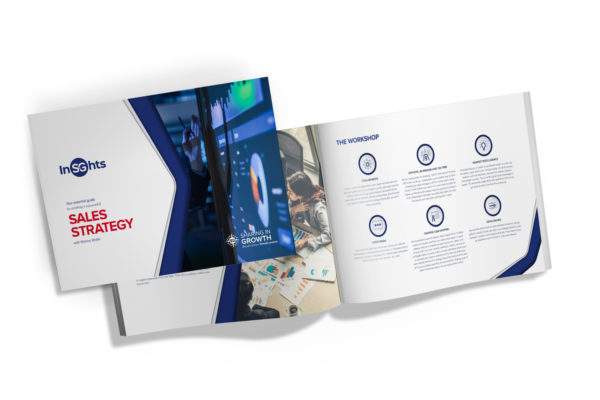
The sales strategy workshop

Collaborate
Foster a culture of collaboration. Your team members are your greatest assets. Don’t jump straight to action planning. Assume positive intent, encourage open dialogue, test assumptions (especially yours), welcome diverse perspectives, and empower your team to contribute to the strategy. Remember: you don’t know everything.

Off-Site, In-Person and On-Time
We are making room for thinking. “OSPO” (Off-site and Phones Off) is the way to go. Collaboration works better face-to-face. Creating your sales strategy in AP12 is hardly worth doing. Three months before your next FY is a minimum to allow for follow-up thought and analysis. Have an agenda and keep to it (an independent facilitator can really help here). Do your homework, and have facts and figures to hand.

Market Intelligence
Understanding your market is key. Market insight provides the foundation upon which your strategy stands. Conduct surveys, analyse customer feedback, and read the industry reports. Knowledge is power. This is worth saying twice: knowledge is power. The leadership might define the aspirations but how to get there should come from the bottom up.

Customers
Your customers aren’t just the people that pay you; they’re relationships. Understand their hot buttons. A customer-centric approach is not just a buzzword; it’s a fundamental philosophy that should guide every decision you make.

Change can happen
You’ve probably heard of Nassim Taleb’s Black Swan. Unlikely events do happen, and they can make a big impact. A good strategy helps you weather unexpected storms. Here’s a bit of jargon (it’s not even a word): antifragile. Taleb’s concept of antifragile refers to systems that not only withstand shocks and uncertainty, but improve and thrive in the face of challenges and volatility. Review the strategy frequently, not just at the end of the year; perhaps quarterly or even monthly. That big gust of wind? That freak wave? You are ready at the rudder.

Data-driven
Harness this information to make informed decisions. Identify patterns, predict trends, and tailor your strategy based on solid evidence. Careful; avoid analysis paralysis. I have had to break up arguments over fractions in a ten-year-forecast.
Final Thought – A3 Thinking
You’ve got your strategy and you need to track and communicate it. Make sure your CRM categorises opportunities in a way that aligns with your strategy to make tracking easier. Avoid lengthy slide decks. Compress the strategy into one piece of A3. Don’t just create dots; join them together. Use the document in your meetings, PDRs, and sales pipeline reviews. Own it, mean it, live it. Make sure everyone understands it and how they can make an impact.
I hope you enjoyed reading and learning from this article! If you want to learn more about how SiG can accelerate your business growth, click here. You can also follow SiG on LinkedIn by clicking here.